🌈 Sennelier L’aquarelle Watercolor Color Wheel
- Coloring Rainbows
- Feb 15
- 3 min read

Updated: Jun 26
Making ART!! Having FUN!!

🌈 Create a Watercolor Color Wheel Using Sennelier L’Aquarelle 3-Primary Colors
Understanding color theory becomes far more powerful when you experience it directly through paint mixing. One of the best ways to do this is by creating a color wheel using just three primary watercolors.
In this guide, we’ll use Sennelier L’Aquarelle French Artist Watercolors, a professional-grade line known for its honey-based formulation, smooth flow, and luminous color. With just three carefully chosen single-pigment paints, you can build a complete color wheel that reveals how pigments interact across the spectrum.
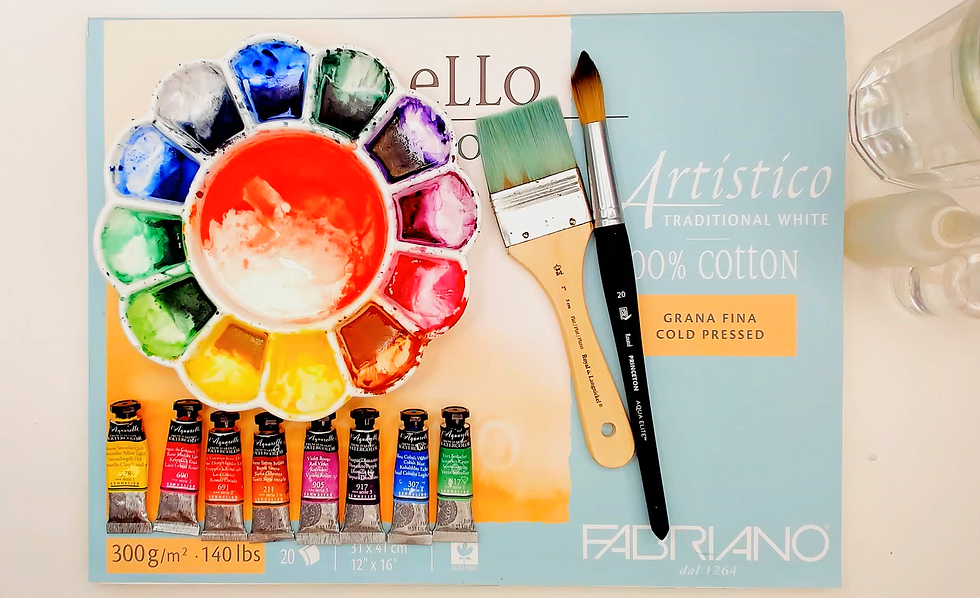
Materials You'll Need
Watercolor paper (cold press, 140lb or 300lb)
Pencil and eraser
Compass or circular template (see below)
Ruler
Round Watercolor Paintbrush
Water container
Palette for mixing
Paper towel
Three primary colors (suggestions below)
Optional:
Waterproof pen for labeling
Color swatch journal

Sennelier L’aquarelle French Artist Watercolors
For this exercise, we’ll use a modern, balanced primary set:
Lemon Yellow (PY3) → bright, cool yellow for clean greens
Quinacridone Red (PR209) → strong, transparent red with excellent mixing clarity
Cobalt Blue (PB28) → natural granulation and softer mixing behavior
This combination blends modern high-chroma mixing (PY3 + PR209) with a classic, granulating blue (PB28), creating a unique balance between clarity and natural texture. The result is a color wheel that is both vibrant and painterly—ideal for artists who want structure with a touch of natural color.
🟡 Lemon Yellow (PY3)
Bright, clean cool yellow
Excellent for luminous greens
High transparency
Strong color mixing clarity
🔴 Quinacridone Red (PR209)
Transparent, high-chroma red
Excellent mixing purity
Produces clean oranges and violets
Slightly cooler than Pyrrol reds
🔵 Cobalt Blue (PB28)
Natural granulation and texture
Softer, more subdued mixing range
Beautiful atmospheric blues
Ideal for landscape transitions
Create a Color Wheel
Here are the instructions for how to create the color wheel:
Step 1: Draw the Color Wheel
Draw a circle and divide it into 12 equal sections for these colors:
3 primary colors
3 secondary colors
6 tertiary colors

Step 2: Paint the Primary Colors
Place your three primaries evenly around the wheel.
Yellow at the top (12 o'clock)
Red on the lower right (4 o'clock)
Blue on the lower left (8 o'clock)
Let the paint dry before continuing.
Step 3: Mix the Secondary Colors
Mix equal parts of neighboring primaries:
Yellow + Red = Orange
Red + Blue = Violet
Blue + Yellow = Green
Place each secondary color between its parent primaries.
Step 4: Create the Tertiary Colors
Fill the remaining six sections by mixing each primary with its neighboring secondary:
Yellow + Orange
Red + Orange
Red + Violet
Blue + Violet
Blue + Green
Yellow + Green
What This Exercise Teaches You
By building a color wheel with these paints, you begin to understand:
How pigment choice affects harmony and mood
Why cobalt blue creates softer mixing behavior
How magenta-leaning reds differ from warm scarlets
How “primary colors” are not fixed—they depend on pigment selection
Most importantly, you see that color theory is not abstract—it is shaped entirely by the physical behavior of real watercolor pigments.
🌈 Final Thoughts
Creating a color wheel with Sennelier L’Aquarelle watercolors is a perfect balance between structure and expression. This palette gives you:
Enough chroma to clearly see color relationships
Enough granulation to preserve watercolor character
Enough softness to feel natural and painterly
It is an ideal exercise for you if you want to understand color theory while still enjoying the organic beauty of traditional watercolor painting.

Thank you for join us at Coloring Rainbows!
Find us on Substack at https://coloringrainbows.substack.com
Find us on Youtube at https://www.youtube.com/@ColoringRainbows


Comments